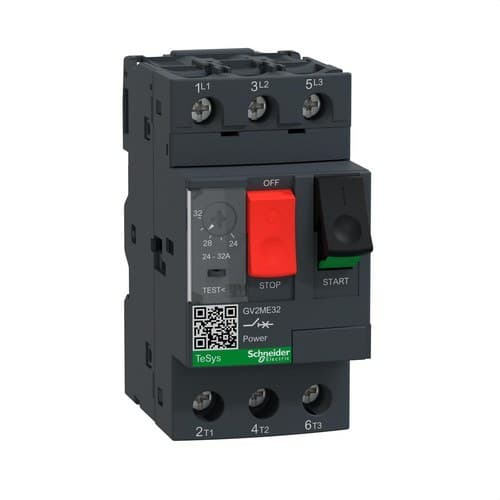
Information about Magnetothermal Circuit Breaker 24-32A
The Schneider Electric TeSys Deca GV2ME32 is a 3-pole motor circuit breaker or thermal-magnetic circuit breaker designed for the protection and manual control of electric motors. It incorporates adjustable thermal protection from 24 to 32 A, instantaneous magnetic tripping at 416 A, and phase-loss sensitivity. In a 400/415 V three-phase network, it can protect motors up to 15 kW and offers an ultimate breaking capacity Icu of 10 kA in accordance with IEC 60947-2.
The GV2ME32 reference belongs to Schneider Electric's TeSys Deca GV2 range and combines overload and short-circuit protection, isolation, and manual control via pushbuttons in a compact device. Its width of only 45 mm, DIN rail mounting, and compatibility with TeSys contactors make it suitable for motor starters, automation panels, machinery, and industrial installations.
Adjustable thermal-magnetic motor circuit breaker from 24 to 32 A
The GV2ME32 uses a thermal-magnetic trip unit. Thermal protection can be adjusted between 24 and 32 A to match the rated current indicated on the motor nameplate.
- Rated current In: 32 A.
- Thermal adjustment range: 24-32 A.
- Number of poles: 3P.
- Trip technology: thermal-magnetic.
- Application: motor protection.
The thermal setting must be adjusted according to the motor's actual rated current and installation conditions, not solely based on its kW power rating.
Overload protection
Thermal protection operates when the motor runs for an extended period above the set current. This situation may occur due to mechanical overload, abnormal operation, or certain fault conditions and can cause excessive heating of the windings.
The adjustable range from 24 to 32 A allows the motor circuit breaker to be set more precisely to the rated current of the protected equipment.
416 A magnetic trip
Short-circuit protection is provided by an instantaneous magnetic trip. Schneider Electric specifies a magnetic trip current Im of 416 A for the GV2ME32.
This mechanism allows the circuit to open rapidly when a very high current caused by a short circuit appears, complementing the thermal protection against overloads.
Phase-loss sensitivity
The GV2ME32 features phase-loss sensitivity in accordance with IEC 60947-4-1.
This function is especially important in three-phase motors, since the loss of one phase can cause severe current imbalance, torque loss, and motor overheating.
Up to 15 kW at 400/415 V
The maximum motor power indicated by Schneider Electric depends on the supply voltage:
- 400/415 V AC: up to 15 kW.
- 500 V AC: up to 18.5 kW.
- 690 V AC: up to 22 kW.
These power ratings are reference values for motors in the corresponding utilization categories. Final selection should always be verified using the motor's rated current, which must fall within the adjustable range of 24 to 32 A.
10 kA breaking capacity at 400/415 V
The ultimate breaking capacity Icu of the GV2ME32 varies according to the network voltage:
- 230/240 V AC: 50 kA.
- 400/415 V AC: 10 kA.
- 440 V AC: 6 kA.
- 500 V AC: 4 kA.
- 690 V AC: 3 kA.
In a conventional 400 V three-phase installation, its Icu is 10 kA in accordance with IEC 60947-2.
Service breaking capacity Ics
Schneider Electric specifies the service breaking capacity Ics as a percentage of Icu:
- 230/240 V: 100% of Icu.
- 400/415 V: 50% of Icu.
- 440 V: 50% of Icu.
- 500 V: 75% of Icu.
- 690 V: 75% of Icu.
Therefore, at 400/415 V the Ics corresponds to approximately 5 kA.
AC-3 and AC-3e utilization categories
The motor circuit breaker is designed for motor control and protection applications in AC-3 and AC-3e categories in accordance with IEC 60947-4-1.
These categories are related to the starting and switching of squirrel-cage motors, making the GV2ME32 especially suitable for direct-on-line starters and motor protection assemblies.
Manual control via pushbuttons
The GV2ME32 uses a front system of start and stop pushbuttons.
From the device itself, it is possible to manually switch the circuit on and off, as well as to obtain automatic tripping when one of its protections operates.
The motor circuit breaker can be complemented with TeSys accessories for locking, signaling, and remote tripping when required by the installation.
Suitable for isolation
Schneider Electric declares the GV2ME32 suitable for isolation in accordance with IEC 60947-1.
This allows it to be used as an isolating device within the safety procedures required for maintenance work, always respecting the applicable regulations and instructions.
Operating voltage up to 690 V
- Rated operational voltage Ue: up to 690 V AC.
- Frequency: 50/60 Hz.
- Rated insulation voltage Ui: 690 V.
- Impulse withstand voltage Uimp: 6 kV.
- Conventional thermal current Ith: 32 A.
Power dissipation
The power dissipation specified by Schneider Electric is approximately 2.5 W per pole.
This value should be considered when calculating the total heat dissipation of the panel, especially when numerous power devices are installed inside a compact enclosure.
DIN rail or plate mounting
The motor circuit breaker can be mounted:
- By clip-on mounting on a symmetrical 35 mm DIN rail.
- Screwed onto a panel using the corresponding adapter.
It can be installed in vertical or horizontal position within the conditions specified by Schneider Electric.
Compact 45 mm format
- Width: 45 mm.
- Height: 89 mm.
- Depth: approximately 78.5 mm.
- Net weight: approximately 0.26 kg.
- Color: dark gray.
Its reduced width makes it possible to integrate complete protection for motors up to 32 A in space-limited panels.
Screw terminals
The GV2ME32 reference uses screw terminals for the power circuit connections.
- Rigid conductor: up to 2 conductors from 1 to 6 mm².
- Flexible conductor without ferrule: up to 2 conductors from 1.5 to 6 mm².
- Flexible conductor with ferrule: up to 2 conductors from 1 to 4 mm².
- Tightening torque: 1.7 Nm.
The specified tightening torque must be respected to ensure a reliable connection and avoid heating at the terminals.
100,000-cycle durability
Schneider Electric specifies a high service life for this motor circuit breaker:
- Mechanical durability: 100,000 cycles.
- Electrical durability: 100,000 cycles under specified AC-3 conditions.
- Rated duty: continuous.
IP20 and IK04 protection
- Degree of protection: IP20 in accordance with IEC 60529.
- Impact resistance: IK04.
The GV2ME32 is intended to be installed inside a panel or enclosure that provides the necessary degree of protection for the working environment.
Environmental conditions
- Operating temperature: -20 to 60 °C.
- Storage temperature: -40 to 80 °C.
- Operating altitude: up to 2,000 m.
- Fire resistance: 960 °C in accordance with IEC 60695-2-11.
Combination with TeSys contactors
The GV2ME32 can be combined with a TeSys contactor to create a complete motor starter, incorporating thermal-magnetic protection and remote electrical switching.
Schneider Electric uses the combination of the GV2ME32 with an LC1D32 contactor as an example for 15 kW motors at 400 V, depending on the coil voltage and starter architecture.
It can also be complemented with auxiliary contacts, undervoltage releases, shunt trips, and other TeSys platform accessories.
Applications of the Schneider Electric GV2ME32
The 24 to 32 A range and the ability to protect motors up to 15 kW at 400/415 V make this motor circuit breaker suitable for numerous professional applications:
- Three-phase motors.
- Pumps.
- Compressors.
- Fans.
- HVAC systems.
- Conveyor belts.
- Industrial machinery.
- Process equipment.
- Automation panels.
- Direct-on-line motor starters.
Does not include residual current protection
The GV2ME32 is a thermal-magnetic motor circuit breaker and protects against overloads, short circuits, and phase loss.
It is not a residual current device and does not detect earth leakage currents. When residual current protection is required, an appropriate residual current device must be installed separately.
Technical characteristics of the Schneider Electric GV2ME32
- Brand: Schneider Electric.
- Reference: GV2ME32.
- Range: TeSys Deca.
- Family: TeSys GV2.
- Type: motor circuit breaker / thermal-magnetic motor circuit breaker.
- Application: motor protection.
- Number of poles: 3P.
- Technology: thermal-magnetic.
- Rated current: 32 A.
- Thermal adjustment range: 24-32 A.
- Magnetic trip: 416 A.
- Phase-loss sensitivity: yes.
- Motor power at 400/415 V: 15 kW.
- Motor power at 500 V: 18.5 kW.
- Motor power at 690 V: 22 kW.
- Icu at 230/240 V: 50 kA.
- Icu at 400/415 V: 10 kA.
- Icu at 440 V: 6 kA.
- Icu at 500 V: 4 kA.
- Icu at 690 V: 3 kA.
- Ics at 400/415 V: 50% of Icu.
- Utilization categories: A, AC-3 and AC-3e.
- Maximum operational voltage Ue: 690 V AC.
- Frequency: 50/60 Hz.
- Insulation voltage Ui: 690 V.
- Impulse withstand voltage Uimp: 6 kV.
- Conventional thermal current Ith: 32 A.
- Dissipation: 2.5 W per pole.
- Control type: pushbuttons.
- Suitable for isolation: yes.
- Terminals: screw terminals.
- Tightening torque: 1.7 Nm.
- Mounting: 35 mm DIN rail or plate with adapter.
- Width: 45 mm.
- Height: 89 mm.
- Depth: approximately 78.5 mm.
- Weight: approximately 0.26 kg.
- Degree of protection: IP20.
- Impact resistance: IK04.
- Mechanical durability: 100,000 cycles.
- Electrical durability: 100,000 cycles under specified conditions.
- Operating temperature: -20 to 60 °C.
- Storage temperature: -40 to 80 °C.
- Maximum altitude: 2,000 m.
- Main standards: IEC 60947-1, IEC 60947-2 and IEC 60947-4-1.
- EAN: 3389110343298.
Compact protection for three-phase motors up to 15 kW
The Schneider Electric TeSys Deca GV2ME32 combines adjustable overload protection, magnetic short-circuit tripping, phase-loss sensitivity, and manual switching in a single device only 45 mm wide.
Its 24 to 32 A range makes it suitable for protecting three-phase motors up to 15 kW at 400/415 V when their rated current falls within that range. The ability to combine it with TeSys contactors and accessories also makes it easy to create compact starters for machinery and industrial automation.
Important: the GV2ME32 is not a residual current device. It does not provide protection against earth leakage currents. To obtain residual current protection, a specific device suitable for the installation characteristics must be added.
