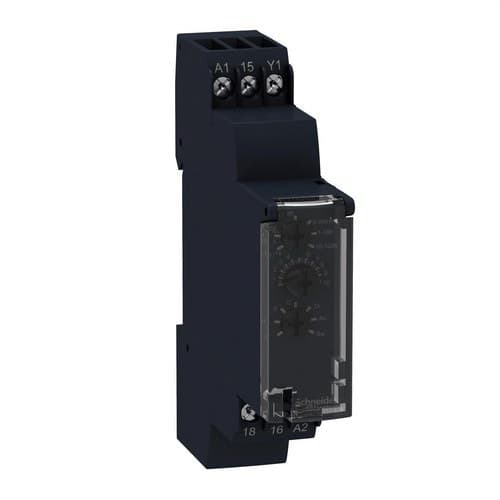
Information about Multifunction Timer Relay 24V DC/24240V AC
The Schneider Electric Harmony RE17RMMU multifunction timer relay is a modular timer for automation and control that combines 10 timed functions in a single compact device. It features a relay output with 1 changeover C/O or SPDT contact rated up to 8 A, universal supply of 24 V DC or 24-240 V AC at 50/60 Hz, and a wide adjustment range from 0.1 seconds to 100 hours. With only 17.5 mm width and DIN rail mounting on a 35 mm rail, it makes it possible to add timing functions to electrical panels and automation systems while occupying the space of a narrow module.
The RE17RMMU reference is part of Schneider Electric's Harmony Timer Relays RE17R range. Its multifunction design allows a single reference to be used for on-delay, off-delay, timed pulse, symmetrical flashing cycles, and control-signal functions. Settings are made directly from the front using rotary selectors protected by a transparent sealable cover, making commissioning easier and preventing accidental changes.
Multifunction timer relay with 10 operating modes
The RE17RMMU integrates 10 selectable timed functions, allowing the output behavior to be adapted to different automation sequences without changing the relay.
- A - On-delay: the output switches after the set time has elapsed from relay power-up.
- At - On-delay with pause/sum: allows timing to be controlled and accumulated via input Y1.
- Ac - On-delay and off-delay with control signal: times both state changes through a control input.
- B - Single interval with control signal: generates a timed activation based on the control signal.
- Bw - Double interval with control signal: provides a timed interval associated with changes in the control signal.
- C - Off-delay: keeps the output active for the set time after the control signal is removed.
- D - Symmetrical flashing with start OFF: alternates equal on and off periods starting with the output deactivated.
- Di - Symmetrical flashing with start ON: alternates equal periods starting with the output activated.
- H - Interval: activates the output for the configured period when the device is powered.
- Ht - Interval with pause/sum: includes Y1 control to stop or accumulate timing.
This combination makes it possible to replace several single-function timers with one reference and simplifies maintenance of panels that require different timing types.
Adjustable timing from 0.1 seconds to 100 hours
The Schneider Electric RE17RMMU offers a wide timing range through different selectable scales:
- 0.1-1 seconds.
- 1-10 seconds.
- 6-60 seconds.
- 1-10 minutes.
- 6-60 minutes.
- 1-10 hours.
- 10-100 hours.
Thanks to these seven scales, the same relay can be used for both very short sequences and processes requiring delays of several hours.
24 V DC or 24-240 V AC supply
One of the main advantages of the RE17RMMU is its wide supply range:
- DC supply: 24 V DC.
- AC supply: 24-240 V AC.
- AC frequency: 50/60 Hz ±5%.
- Operating range: approximately 0.85-1.1 × Us.
This feature makes it easy to use the same reference in panels with different control voltages, reducing the number of models that need to be kept in stock.
Relay output with 1 changeover contact
The timer incorporates 1 C/O changeover contact, also known as SPDT. This contact provides one common terminal, one normally closed terminal, and one normally open terminal.
The changeover configuration allows the same output to be used both to connect and to disconnect a circuit when the timed condition is met.
- Number of contacts: 1 C/O.
- Type: electromechanical relay.
- Maximum switching current: 8 A AC/DC.
- Maximum switching voltage: 250 V AC.
- Breaking capacity: up to 2,000 VA.
- Minimum switching current: 10 mA at 5 V DC.
Output up to 8 A
The RE17RMMU output is rated for a maximum switching current of 8 A. Schneider Electric specifies an electrical endurance of 100,000 cycles with a resistive load of 8 A at 250 V AC.
For loads exceeding the contact rating, or for inductive loads with significant inrush currents, the timer can be used to drive the coil of a properly sized contactor or power relay.
The RE17RMMU is a control and timing relay, so the actual permissible current must always be assessed according to the type of load connected.
Y1 control input
Several of the RE17RMMU functions use the Y1 control input to start, stop, reset, or accumulate timing depending on the selected function.
Schneider Electric specifies a typical control pulse width of:
- 30 ms: typical control signal value.
- 100 ms: typical value when a load is connected in parallel according to the corresponding diagram.
The Y1 input greatly expands integration possibilities in hardwired logic schemes, as it allows the relay's permanent supply to be separated from the signal that starts the timed sequence.
Front adjustment using rotary selectors
Configuration is carried out directly from the front using rotary selectors. The user can select:
- The timing function.
- The time scale.
- The exact value within the selected scale.
The system provides quick configuration without software, a computer, or PLC programming.
Sealable front cover
The adjustment selectors are protected by a transparent sealable front cover.
This solution helps prevent accidental or unauthorized changes after commissioning, while still allowing the selected parameters to be viewed.
Accuracy and repeatability
Schneider Electric specifies the following accuracy characteristics for the timer:
- Repeat accuracy: ±0.5% according to IEC 61812-1.
- Setting accuracy: ±10% of full scale at 25 °C.
- Temperature drift: ±0.05%/°C.
- Voltage drift: ±0.2%/V.
- Typical reset time: 120 ms after de-energization.
These features make the RE17RMMU suitable for automation systems where repeatable timing is required without using a programmable controller.
LED status indicator
The relay includes LED indication to make local monitoring of operation easier.
The LED behavior allows states such as:
- Relay energized with no timing in progress.
- Timing active.
- Relay de-energized with no timing in progress.
This indication is especially useful during commissioning, maintenance, and control-sequence troubleshooting.
Ultra-compact 17.5 mm format
The RE17RMMU has a narrow body that makes installation easy even in panels with limited space.
- Width: 17.5 mm.
- Height: 90 mm.
- Depth: 72 mm.
- Weight: approximately 70 g.
Its 17.5 mm width is similar to that of a single-pole modular device, allowing more automation functions to be concentrated on the same rail.
35 mm DIN rail mounting
The timer is designed for mounting on a 35 mm DIN rail in accordance with IEC 60715.
Schneider Electric allows installation in different orientations relative to the normal vertical position, providing flexibility during panel design.
Screw terminals
Connection is made using screw terminals. Depending on the type and number of conductors, it accepts different cross-sections:
- 1 rigid conductor: approximately 0.5-3.3 mm².
- 2 rigid conductors: approximately 0.5-2.5 mm².
- 1 flexible conductor with ferrule: approximately 0.2-2.5 mm².
- 2 flexible conductors with ferrule: approximately 0.2-1.5 mm².
- Tightening torque: 0.6-1 Nm.
Self-extinguishing polycarbonate housing
The relay body is made of polycarbonate, and the technical documentation specifies self-extinguishing characteristics suitable for use inside electrical panels and automation systems.
Low power consumption
The timer itself has low power consumption:
- Maximum consumption at 24 V DC: approximately 0.6 W.
- AC supply consumption: up to 32 VA at 240 V AC under the specified conditions.
- Load factor: 100%.
High durability
The RE17RMMU is designed for a high number of operations:
- Mechanical endurance: up to 10,000,000 cycles.
- Electrical endurance: up to 100,000 cycles with a resistive load of 8 A at 250 V AC.
Effective electrical life depends on the voltage, current, and nature of the connected load.
Insulation characteristics
Main electrical and dielectric performance characteristics include:
- Insulation resistance: 100 MΩ at 500 V DC according to IEC 60664-1.
- Dielectric strength: 2.5 kV for 1 minute at 50 Hz according to IEC 61812-1.
- Impulse withstand voltage Uimp: 5 kV with 1.2/50 µs waveform.
Applications of the Schneider Electric RE17RMMU
The combination of 10 functions, seven timing scales, and multi-voltage supply makes the RE17RMMU suitable for numerous automation and control systems.
- Delayed start of equipment.
- Delayed stop of fans.
- Machine sequencing.
- Pump control.
- HVAC systems.
- Ventilation and extraction.
- Building automation.
- Filling and emptying processes.
- Lighting control.
- Timed alarms.
- Delays between contactors.
- Generation of timed pulses.
- Cyclic flashing.
- Upgrading hardwired automation without a PLC.
Useful for modernizing automation without a PLC
Schneider Electric highlights the RE17RMMU as a particularly practical solution for upgrading existing hardwired installations. By including multiple functions in a single relay, it can replace different specialized timers without the need to install a PLC for simple automation tasks.
This can simplify both design and maintenance and reduce the variety of spare references required.
Technical characteristics of the Schneider Electric RE17RMMU
- Brand: Schneider Electric.
- Reference: RE17RMMU.
- Range: Harmony Timer Relays.
- Family: RE17R.
- Type: multifunction modular timer relay.
- Number of functions: 10.
- Functions: A, At, Ac, B, Bw, C, D, Di, H and Ht.
- Total timing range: 0.1 seconds-100 hours.
- Scales: 0.1-1 s; 1-10 s; 6-60 s; 1-10 min; 6-60 min; 1-10 h; 10-100 h.
- Output: electromechanical relay.
- Contacts: 1 C/O, SPDT.
- Maximum switching current: 8 A AC/DC.
- Maximum switching voltage: 250 V AC.
- Breaking capacity: up to 2,000 VA.
- Minimum switching current: 10 mA at 5 V DC.
- DC supply: 24 V DC.
- AC supply: 24-240 V AC.
- Frequency: 50/60 Hz ±5%.
- Voltage range: 0.85-1.1 × Us.
- Control input: Y1 for the corresponding functions.
- Repeat accuracy: ±0.5%.
- Setting accuracy: ±10% of full scale at 25 °C.
- Thermal drift: ±0.05%/°C.
- Voltage drift: ±0.2%/V.
- Reset time: approximately 120 ms.
- Maximum consumption at 24 V DC: 0.6 W.
- Maximum consumption indicated at 240 V AC: 32 VA.
- Indication: front LED.
- Adjustment: front rotary selectors.
- Cover: transparent and sealable.
- Terminals: screw.
- Tightening torque: 0.6-1 Nm.
- Housing material: polycarbonate.
- Mounting: 35 mm DIN rail.
- Width: 17.5 mm.
- Height: 90 mm.
- Depth: 72 mm.
- Weight: approximately 70 g.
- Mechanical endurance: 10,000,000 cycles.
- Electrical endurance: 100,000 cycles at 8 A/250 V AC with resistive load.
- Insulation resistance: 100 MΩ at 500 V DC.
- Dielectric strength: 2.5 kV.
- Uimp: 5 kV.
- Main standard: IEC 61812-1.
- Marking: CE.
- EAN: 3606480552755.
Compact and versatile timer for automation
The Schneider Electric Harmony RE17RMMU combines ten timing functions, scales from 0.1 seconds to 100 hours, 24 V DC or 24-240 V AC supply, and a changeover output rated up to 8 A in a body only 17.5 mm wide.
Its wide supply range, front selector adjustment, LED indication, and functions with Y1 control input make it a versatile solution for hardwired automation, machinery, pumping, ventilation, HVAC, and building control.
Important: the RE17RMMU is a timing and control relay; it does not provide protection against overloads, short circuits, or earth leakage. When controlling power loads, it must be used together with the appropriate protection and switching devices. The contact rating must also be checked according to the type of load, especially for motors, contactors, lighting, and inductive loads with high inrush currents.
